Update Member ProfileMember:
Since:Until:
Level: None
This site uses optional analytics cookies to help improve content and usability. Learn more
This Privacy Policy sets out our commitment to protecting the privacy of personal information provided to us, or otherwise collected by us, offline or online, including through this website (Site). In this Privacy Policy we, us or our means Upper Blue Mountains Bushwalking Club Incorporated (Incorporation No. Y1580033).
Personal information: The types of personal information we may collect include:
We may collect these types of personal information directly from you or from third parties.
We may collect, hold, use and disclose personal information for the following purposes:
We may disclose personal information to:
By providing us with personal information, you consent to the disclosure of that personal information to third parties who reside outside Australia and acknowledge that we are not required to ensure that those third parties comply with Australian privacy laws.
Choice and consent: Please read this Privacy Policy carefully. By providing personal information to us, you consent to us collecting, holding, using and disclosing your personal information in accordance with this Privacy Policy. You do not have to provide personal information to us, however, if you do not, it may affect your use of this Site or the products and/or services offered on or through it.
Information from third parties: If we receive personal information about you from a third party, we will protect it as set out in this Privacy Policy. If you are a third party providing personal information about somebody else, you represent and warrant that you have such person’s consent to provide the personal information to us.
Restrict: You may choose to restrict the collection or use of your personal information. If you have previously agreed to us using your personal information for direct marketing purposes (for example for the Walks Program and notice of AGM Meetings)., you may change your mind at any time by contacting us using the details below.
Access: You may request details of the personal information that we hold about you. An administrative fee may be payable for the provision of such information. In certain circumstances, as set out in the Privacy Act 1988 (Cth), we may refuse to provide you with personal information that we hold about you.
Correction: If you believe that any information we hold about you is inaccurate, out of date, incomplete, irrelevant or misleading, please contact us using the details below. Please inform us and take reasonable steps to correct any information found to be inaccurate, incomplete, misleading or out of date in the Profile Form in the Members Area.
Complaints: If you believe that we have breached the Australian Privacy Principles and wish to make a complaint, please contact us using the details below and provide us with full details of the alleged breach. We will promptly investigate your complaint and respond to you, in writing, setting out the outcome of our investigation and the steps we will take to deal with your complaint.
Unsubscribe: To unsubscribe from our e-mail database or opt-out of communications (including marketing communications), please contact us using the details below or opt-out using the opt-out facilities provided in the communication.
We are committed to ensuring that the personal information we collect is secure. In order to prevent unauthorised access or disclosure, we have put in place suitable physical, electronic and managerial procedures to safeguard and secure the personal information and protect it from misuse, interference, loss and unauthorised access, modification and disclosure.
Although we take measures to safeguard against unauthorised disclosures of information, we cannot assure you that the personal information we collect will not be disclosed in a manner that is inconsistent with this Privacy Policy. We cannot guarantee the security of any information that is transmitted to or by us over the Internet. The transmission and exchange of information is carried out at your own risk.
We may use cookies on our Site from time to time. Cookies are text files placed in your computer's browser to store your preferences. Cookies, by themselves, do not tell us your email address or other personally identifiable information. However, they do allow third parties, such as Google and Facebook, to cause our advertisements to appear on your social media and online media feeds as part of our retargeting campaigns. If and when you choose to provide our Site with personal information, this information may be linked to the data stored in the cookie. We provide a method for disabling cookies on our Manage Cookies page. If you do not want the tracking cookies please ensure you disable them.
We may use an analytics provider to collect and process data.
Our Site may contain links to other websites. We do not have any control over those websites and we are not responsible for the protection and privacy of any personal information which you provide whilst visiting those websites. Those websites are not governed by this Privacy Policy.
We may, at any time and at our discretion, vary this Privacy Policy by publishing the amended Privacy Policy on our Site. We recommend you check our Site regularly to ensure you are aware of our current Privacy Policy.
For any questions or notices, please contact our Privacy Officer at:
1. Every person participating in an activity organized by the UBMBC does so at his/her own risk and by participating acknowledges that neither the UBMBC, its office bearers or its activity leaders have accepted any responsibility or liability for any damage to property or for any death or injury suffered.
As a bushwalking club, UBMBC has a duty of care to its members. Bushwalking Australia defines “duty of care” as “What a reasonably prudent person would do to take reasonable care to avoid exposing fellow participants (having regard to their knowledge, age, experience and skill) to unreasonable risks of injury or loss.”
We expect that activity leaders and participants will take responsibility for their own welfare and safety in a manner consistent with their knowledge, age, experience and skill. All participants and leaders need to take reasonable care to avoid exposing any person including other participants to unreasonable risk of injury or loss.
2. When participating in club activities, members of UBMBC are covered by insurance policies through Bushwalking NSW and Bushwalking Australia. We have Personal Accident and Public Liability Insurance.
3. We follow ethical practices in relation to the conservation of flora, fauna, rock formations and archaeological sites set out in the Bushwalker's Code.
4. All Club Activities are strictly NON-SMOKING. Smoking is prohibited in all NSW National Parks & State Conservation Areas and in most areas in NSW State Forests.
1. The club activity program is emailed to members and can be accessed on the club website ubmbc.org.au. We use the Bushwalking Australia grading guide. The Grading Guide gives walkers an idea of the difficulty. If you are uncertain about your ability to participate in an activity, please discuss with the leader.
2. New club members with limited walking experience should attempt a grade 2/3 walk for their first activity. This enables them to become accustomed to the club and allows leaders to assess their ability.
3. Joining a walk. The leader’s contact details appear in the program. Members should ask to join the walk. For new walkers the leader will ask questions about fitness, recent walking experience and equipment. The leader is entitled to refuse participation in an activity.
4. Tell someone where you are going and when you expect to return. It is not possible for the walk leader to give an exact return time. There are many reasons why a group maybe overdue, weather conditions, injuries, change of route, vehicle problems may occur. This rarely happens with UBMBC.
5. Meeting Arrangements. Clarify the time and meeting place with the leader. Be on time. If you are delayed contact the leader’s mobile. If you have booked in for a walk and are unable to attend please inform the leader. The leader will wait no longer than five minutes if you are late.
6. Your Emergency Contact and Medical Information form, downloaded from the club website should be in your first aide kit in your backpack. This form will only be accessed in case of an accident or medical emergency.
7. Advise the leader in advance if you have a medical or physical condition that may affect your performance.
8. Advise the leader if you have skills such as first aid, navigation or knowledge of the area.
9. Make sure that you are fully equipped for the activity. A list of what to take on a walk is on the Frequently Asked Questions section of our club website.
10. First Aid Kit. Members are required to have their own first aid kit in their backpack. This enables first aid kits to combined in the case of multiple injuries or injuries to several people. If the group is separated or someone is lost it means that everyone has a first aid kit. Suggestions for items in your first aid kit is on the Frequently Asked Questions section of our club website. The UBMBC subsidises first aid training for members.
11. Guests. Visitors may take part in activities subject to the leader’s prior approval. Visitors must complete a , downloaded from the club website. Juniors (under 18) must also be approved by the leader, complete a and be accompanied by a parent, guardian or grandparent who is responsible for the junior.
12. Advise the leader if you would not like to be photographed during the walk.
1. Please assist the leader by being co-operative and enthusiastic. Follow the leader’s instructions and accept the leader’s judgement. Our leaders are experienced walkers who are volunteers.
2. Be prepared to car pool with others and to make a contribution for fuel.
3. Treat other group members with respect. UBMBC is a very friendly club where members help and support each other. Be prepared to learn from other members.
4. Advise the leader if you have any concerns. Eg the pace is too fast, you are feeling unwell, you have run out of water.
5. Do not become separated from the group. Call out if gaps get too large. A whistle can be useful.
6. Members are encouraged to carry a map and compass and to become proficient in using them.
7. Leave sufficient distance between yourself and the walker in front of you so that you are not injured by branches or walking poles.
8. Be aware of loose rocks. If a rock is dislodged, call “Rock!” to alert the group.
9. Emergency Procedure. If you have phone coverage, phone 000 (triple zero) Ask for police and be prepared to give map name and grid references for your position. If phone contact is not possible then activate the PLB.
1. Let the leader know that you have completed the activity.
2. Thank the leader and offer feedback on the walk.
3. Advise your emergency contact person that you are home.
4. To inhibit the spread of plant diseases and seeds, wash footwear, trousers and other equipment before your next bushwalk.
This acknowledgement of risks applies to all Club activities I may undertake as a member of Upper Blue Mountains Bushwalking Club (the Club). In voluntarily participating in activities of the Club which are described to me by the activity leaders I am aware that my participation in the activities may expose me to hazards and risks that could lead to injury, illness or death or to loss of or damage to my property. I also acknowledge that I may encounter weather conditions that could lead to hypothermia and being in locations where evacuation for medical treatment may take hours or days. In particular when participating in club activities, such as above the snowline activities I am aware that these activities could expose me to additional hazards and risks.
To minimise these risks I will endeavour to ensure that:
Members should be familiar with the Clubs “Guidelines for Walkers” and “Risk Management Guidelines”. Additionally leaders should be familiar with “Guidelines for Walk Leaders”.
By accepting this Waiver I agree to waive any claim for damages that I may have against the Club, the leader or other participants in tort or contract.
I also agree to be bound by the constitution of the Club for the time being in force.
I have read and understand the above requirements; I have considered the risks before choosing to accept this acknowledgment of risk. I still wish to join the activities of the Club. I acknowledge that I will take responsibility for my own actions and that agreeing to this form and the payment of my subscription will be deemed as full acceptance and understanding of the above conditions.
To participate in a canyoning trip you must be a current member of the Upper Blue Mountains Bushwalking Club and have been approved to join the canyoning group. You must also agree to this acknowledgement.
If I do not understand anything mentioned in this acknowledgement I will seek clarification from the Canyoning Subcommittee before agreeing to it.
By voluntarily agreeing to this acknowledgement
Note: This acknowledgement is in addition to and supplementary to the “Acknowledgement of Risks and Obligations of Members” that I agreed to on joining the club or renewing my membership.
1. If you are unfamiliar with a walker, ask questions to determine their experience, membership status and capabilities. Ask if the walker has a medical condition that could affect them during the walk. Leaders have the right to refuse participation in a walk. After 3 walks a temporary member is required to join the club.
2. Be aware that NPWS limits group size to 8 in wilderness areas.
3. If possible, survey the route. Check the weather forecast. Check local events as well as NPWS track and park closures. Note hazards and identify risks such as exposure and creek crossings. Be aware of changes due to track erosion or flooding. Is a rope or tape required? Where are alternate exits?
4. Proposed walks, including Short Notice Walks, may be entered in the activities program on the club web site for approval by Walks Secretary, Rob Herbert. If Rob is unavailable check with the designated Committee member, currently Peter Medbury. If the walk is a joint walk with other clubs, please list the Club Names in the 'Other Clubs' field on the 'Add Walk to Program' form.
5. Details of the walk (and photographs) can be advertised on the Club's Google Group.
6. On the day before the walk email late-returns-ubmbc@googlegroups.com with the names of the people on your walk. If the walk is delayed, the committee is then able to answer enquiries. Make sure a contact person is aware of the route you are taking and the expected return time. An updated email is required to late returns if there are any changes to participants or if the activity is cancelled.
7. The leader should ensure that someone in the group has a map, compass, mobile phone, GPS and PLB. The PLB and walk details can be registered on the Australian Marine Safety Authority website. Leaders are encouraged to learn how to do this.
8. Visitors must be approved by the leader and bring a signed temporary membership form to the walk (This a mandatory requirement for Bushwalking Australia). Originals or scanned copies must be sent to the Walks Recorder, Onni Elliott.
9. Organize transport and meeting points.
10. Make sure you have each participant's mobile number and they have yours.
11. If you wish to walk through private property, ensure you have the owner's permission.
1. Know the experienced members and newer walkers in your group. Be aware who has first aid qualifications and who is carrying a mobile phone or PLB.
2. Before the walk introduce the members and outline the walk. Explain the terrain, hazards and expected return time.
3. Wait 5 minutes for people who may have been delayed at the meeting place.
4. Check that all participants are equipped for the walk. Water, food, wet weather gear, sunscreen, first aid kit etc. Check that each Club member is carrying an emergency contact sheet in their first aid kit.
5. Appoint a "tail" and a deputy leader.
6. The leader sets the pace. Remember the group can only move at the rate of the slowest walker. Have regular breaks for drinks and regrouping. Check that all walkers are present.
7. Keep a record of any injury or incident that occurs during the walk and report to the Secretary.
8. Emergency Procedure. If you have phone coverage, phone 000 (triple zero.) It is advisable to have the Emergency+ app installed on your phone. This app also provides your location in the format preferred by the emergency services. Ask for police and be prepared to give map name and grid references for your position. If phone contact is not possible then activate the PLB. (This is the advice from the RAFA course. The police co-ordinate rescues so we were told to ask for the police first not ambulance or fire).
1. Check that all walkers are present.
2. Remind members to pay their contribution for travel.
3. Wait until all vehicles have started before driving off.
4. After the activity please email Late Returns to advise that the group has finished the activity. If there were any changes to participants or if the activity was cancelled, please include this information in the email.
5. Email a scan or photo of any temporary membership forms to the Walks Recorder, Onni Elliott.
6. Advise your emergency contact person that you have returned.
Technical canyoning is physically and mentally demanding and may involve: carrying heavy gear whilst walking off-track in rugged terrain with steep climbs and descents; swimming and wading in deep, cold, creeks, pools, and fast-moving water; encounters with escarpments, exposed cliff-lines, open face waterfalls, narrow gorges, tunnels, passages and cave-like formations. Rappelling, also known as abseiling, is the act of descending a rope or pair of ropes in a controlled way. Refer to UBMBC Canyoning Program document for information about the program.
All members intending to join the UBMBC canyoning program must complete a creek walk with UBMBC.
Members who are new to canyoning must also complete an abseil training course with an accredited commercial training provider. After completing this, members should apply to the UBMBC canyoning subcommittee (canyoning@ubmbc.org.au) to attend an UBMBC rope practice day for the purpose of skills assessment.
Experienced canyoners should submit their relevant and recent canyoning experience to the UBMBC canyoning subcommittee (canyoning@ubmbc.org.au) and attend a UBMBC rope practice day for the purpose of skills assessment.
In joining or renewing membership with UBMBC, members who participate in canyoning must indicate that they have read, understood and accepted the UBMBC Canyoning Waiver by checking the box on the club website. The waiver describes the risks associated with canyoning and must be completed annually.
Canyons are graded, (see UBMBC Canyoning Activity Grading document) from 1 to 5 based on factors such as abseil length, difficulty, access, starts, swimming, exposure, etc.
Canyoning details and contact information are found in the Activities area on the UBMBC website. Commitment is important for canyon bookings. Advise the leader of medical conditions, physical limitations or communication problems that may affect you on the activity.
Acceptance for trips is not on a "first come, first served" basis. Whether the leader accepts your booking, or not, is based on group needs, canyon activity grading and members' skills to ensure safety and enjoyment. Inform the leader of any useful skills you possess, such as navigation, medical expertise or canyon knowledge.
When moving through a canyon, do not become isolated. Stay with at least one other person and in sight of others behind, particularly when swimming or rock scrambling. If you lose sight of the person in front, yell out for them to stop and wait for you. Collaborate with others and be ready to assist with canyon tasks. Offer help or advice if requested.
The leader determines the approach route, the way through the canyon and exit. Do not proceed ahead of the leader unless instructed. Canyoners must follow the leader’s instructions and cooperate.
The canyon environment can be dark, noisy (water falls), echoing, disorienting, many times the abseiler can’t be seen by the belayer or the anchor manager. If, at any time, a member is feeling unwell, unsafe, or uncomfortable they should inform the leader who will take appropriate action. Members are encouraged to raise issues of concern.
The use of loud verbal calls (for example: “On Rope”, “Abseiling”, “Stop”, “Off Rope”, “Rope Down”, “Rope Up”, “Help”), whistles, UHF radios and hand signals are used to communicate in the canyon environment.
Canyoners should learn these methods of communication and discuss with the leader what methods will be used on the trip.
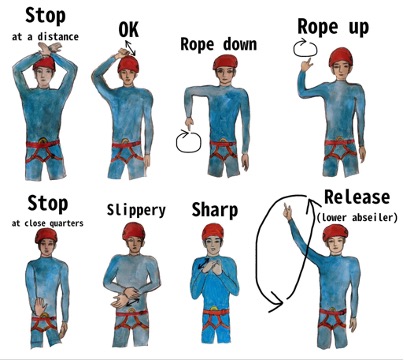
Canyoners should continually improve their skills. Each canyon presents a learning opportunity, with members sharing their knowledge. UBMBC provides abseil, skills and rescue practice sessions. There are many online and physical resources which facilitate technical canyoning skill development.
Most canyons are accessed by bushwalking, so the UBMBC Guidelines for Walkers document also applies to canyoning. This includes carrying a first aid kit, additional supplies in case of benighting and an emergency contact form in your backpack.
Canyoners should be familiar with their abseiling equipment and how to safely abseil on different types of rope. They should be able to use prusiks for self rescue.
If possible, stay at least two body lengths from exposed edges unless attached to a safety line or on rope.
Use of ABCDE checks is essential for every abseil.
The first person abseiling is advised to use a VT prusik (self-belay), French Prusik (autoblock) or be top belayed (depending on conditions).
A bottom belay or fireman's belay involves a belayer holding the abseil rope at the bottom of an abseil. If the abseiler slips, a sharp pull and hold of the rope is required to stop the uncontrolled descent. Ongoing communication with the abseiler assists the abseiler with the remaining descent.
If a bottom belay is used, the abseiler shouts, “On rope!” (two whistle blasts). The belayer responds with “On Belay!” (two whistle blasts) when ready. The abseiler releases their safety lanyard, calls “Abseiling!” (two whistle blasts) and begins the descent.
Shout “Rock!” repeatedly if a rock is dislodged during abseil until the hazard has cleared.
After completing the abseil, canyoners should be well clear of the area below the abseil to avoid falling rocks.
In certain situations the leader may determine that a canyoner requires a top belay. A top belay is when an abseiler is connected to a separate belay rope. The top belayer can manage the descent in case the abseiler loses control.
Strive to minimize your impact on the canyon environment. Before the trip, clean your footwear and equipment to prevent the spread of soil-borne pathogens.
Walk on rocky areas or established routes and avoid muddy or loose ground, vegetated, moss-covered, or steep creek banks. Carry out all food scraps and rubbish. Regarding human waste - leave no trace! A WAG bag should be used in a canyon.
Canyoners comply with all NPWS adventure sports policies. Canyon wildlife, including birds, yabbies, snakes and lizards should be left undisturbed.
Members are responsible for the care and maintenance of their equipment. Climbing or canyoning helmets, harnesses, descenders and carabiners must comply with European or North American standards and be used as intended by the manufacturer.
Helmets from other sports are not acceptable. Helmets are to be worn when abseiling, belaying and in the canyon. The leader may require members to wear helmets on the approach or exit of the canyon.
Members require the following equipment:
Leaders may also advise additional equipment depending on conditions, for example:
Leaders may refuse participation if equipment is missing, does not meet standards or is damaged. For more information on canyon gear see Canyoning Australia.
Ropes are supplied by the leader or group members at the leader’s request. They must be in good condition and may be inspected by members. The length of each rope should be known by the owner and conveyed to the leader and group. Ropes should have clear length markings at the ends of the rope.
Any damage or wear on ropes should be reported to the leader immediately.
When not in use, ropes are to be carried inside packs or rope bags, except when anchor points are close to each other. Who carries ropes is decided by the leader.
It is recommended that ropes be isolated below the anchor point (e.g. with double alpine butterfly knot, ATC guide (Jester), stein knot, etc.), except for the last person who will remove the isolation before descending. The leader decides whether the abseil is rigged single rope, double rope or releasable.
Grade 5 canyoners are permitted to rig anchors. Grade 4 canyoners may rig if supervised by a grade 5.
Canyoning is an outdoor adventure activity that typically involves bushwalking, swimming, wading, abseiling, and rock scrambling techniques in order to negotiate a diverse range of river and creek systems. As with all club activities, safety of participants is of paramount importance.
Guidance for Leaders is provided in the following UBMBC documents:
Trip leaders who have been approved by the subcommittees may submit canyoning trips to the UBMBC walks secretary. The activities page on the club website requires leaders to complete details of the trip. These include date, activity grade, leader, assistant leader, contact details, number of participants and map. The trip is subject to approval by the walks secretary.
Once the trip is approved by the walks secretary, the leader may inform club members by email to Canyons_abseiling_ubmbc@googlegroups.com google group. Members who are approved to participate in the canyon may contact the leader to request participation. The leader will consider the composition of the group in deciding who joins the trip. The leader then informs participants, providing meeting details, travel arrangements and any additional information.
The leader should have at least one of each of the following items in addition to the personal items required for canyoning.
Leaders are experienced technical (abseiling) canyoners with advanced abseiling skills.
They should also have good interpersonal skills to develop teamwork and cohesion within the group. They should try to utilise members’ expertise to enhance group performance and be proficient in managing group participation, logistics, risk assessment and unanticipated problems that may arise during the canyon.
It is also acknowledged that qualities such as sound judgement, compassion and fairness are vital for canyon leaders but are less easily measured than skills, knowledge and experience.